

A mandatory protection order is automatically issued any time someone is arrested and charged with a domestic violence offense in Colorado. Unlike a civil restraining order, which requires a separate court petition, this order takes effect the moment a defendant appears before a judge and remains in place throughout the criminal case.
If you are facing domestic violence charges in Denver, the implications of a mandatory protection order can be immediate and far-reaching. At Shazam Kianpour & Associates, we have more than 22 years of experience defending people who are navigating the serious and often overwhelming consequences that follow a domestic violence arrest in Colorado.
What a Mandatory Protection Order Requires
A mandatory protection order, governed by C.R.S. 18-1-1001, is a court-issued directive placed on the defendant at their first hearing. It is not optional, and no judge has the discretion to skip it in a domestic violence case. The order remains active from the initial appearance until the final disposition of the action, and that does not simply mean when a verdict is reached. Under the statute, “final disposition” means until the case is dismissed, until the defendant is acquitted, or until the defendant completes the sentence. A defendant sentenced to probation is not considered to have completed the sentence until discharged from probation. A defendant sentenced to incarceration is not considered to have completed the sentence until released from incarceration and discharged from parole supervision. In short, a conviction does not end the order. It remains fully in effect until the defendant is completely off paper.
Standard Conditions of the Order
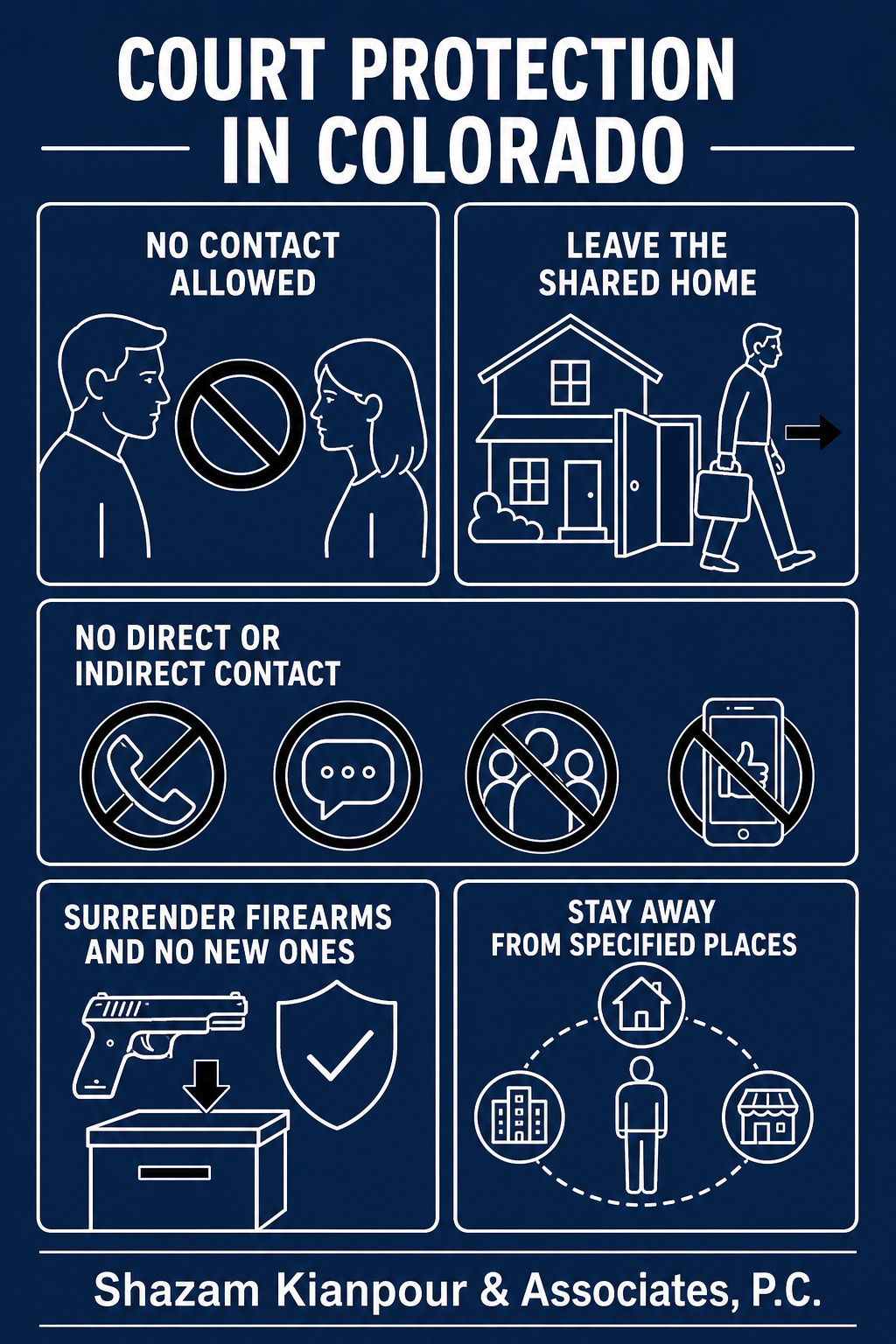
The baseline protections built into every mandatory protection order prohibit the defendant from harassing, contacting, or communicating with the alleged victim, either directly or indirectly. The full scope of restrictions the court may impose under restraining orders and mandatory protection orders can go significantly further depending on the circumstances of the case. These may include:
- Vacating the shared home: The defendant may be ordered to leave their own residence immediately, regardless of whose name is on the lease or mortgage.
- No-contact provisions: All direct and indirect contact with the alleged victim, including through third parties or social media, is prohibited.
- Firearm surrender: Colorado law requires defendants to relinquish any firearms and to refrain from purchasing or possessing new ones for the duration of the order.
- Stay-away orders: The defendant must remain at a specified distance from the alleged victim’s home, workplace, or other locations the alleged victim is likely to frequent.
Violating any of the terms is a separate criminal offense under C.R.S. 18-6-803.5 and can result in additional charges on top of the underlying domestic violence case.
When the Order Can Be Modified
Under Colorado law, a mandatory protection order can be modified or dismissed before the case concludes, but doing so requires a formal motion and court approval. The defendant, their attorney, or the district attorney may petition the court at any time for a change to the order’s terms. Understanding how to approach a modification request is critical, and doing so without experienced legal counsel rarely goes well.
How a Mandatory Protection Order Differs from a Civil Restraining Order
Many people confuse a mandatory protection order with a temporary restraining order or other civil protection orders. The differences matter significantly for your defense strategy.
The alleged victim initiates a civil protection order through a separate civil court filing. It can be granted without the defendant present at the initial hearing, and it operates independently of any criminal case. A mandatory protection order, by contrast, is a criminal court order. The judge issues it in your criminal proceeding; it does not require the alleged victim to file anything, and it is not negotiable at the time of issuance. Both types of orders can coexist, so defendants often feel the full weight of legal restrictions before their cases have even had a chance to move forward.
The Bail Requirement You Need to Know
Colorado law adds a layer that sets domestic violence cases apart from most other criminal matters. Per the Colorado mandatory arrest domestic violence law, when someone is arrested for domestic violence, they are required to spend the night in jail. Bail cannot be set until the following day, and a mandatory protection order must be issued by the judge before bail is even considered. This cooling-off period is deliberately built into the statute, meaning that even defendants with no prior record face an automatic overnight hold.
Before release, the defendant must acknowledge the terms of the mandatory protection order on the record and in writing. Compliance with the order then becomes a condition of the bond itself, meaning any violation can result in immediate rearrest and revocation of bail.
Speak with Shazam Kianpour & Associates Today
A mandatory protection order can disrupt your housing, your relationships, and your daily life before you have had any opportunity to tell your side of the story. That is why having a defense attorney involved as early as possible matters. Shazam Kianpour & Associates is a proud member of the Colorado Bar Association, the Denver Bar Association, the American Association for Justice, and the Colorado Criminal Defense Bar. The firm has earned recognition from both the National Trial Lawyers and Super Lawyers, and Shazam Kianpour has built a reputation in Colorado courts as a fearless fighter for his clients.
Whether you are looking to understand what the order means, pursuing a modification, or mounting a full defense against the underlying charges, we are ready to help. Reach out to us today through our online contact form to get started.

Written by
Shazam KianpourDenver Criminal Defense Attorney & Founder, Shazam Kianpour & Associates, P.C. — Over 10,000 criminal and traffic cases handled across Colorado.